Musical compositions which are about Utah, even if just in the title, but composed by people who were/are not residents. Most of the selections here are piano solos, but are thematically at home in this list as well.
… Including a sample of works in various styles. We will soon be adding additional selections to appear here …
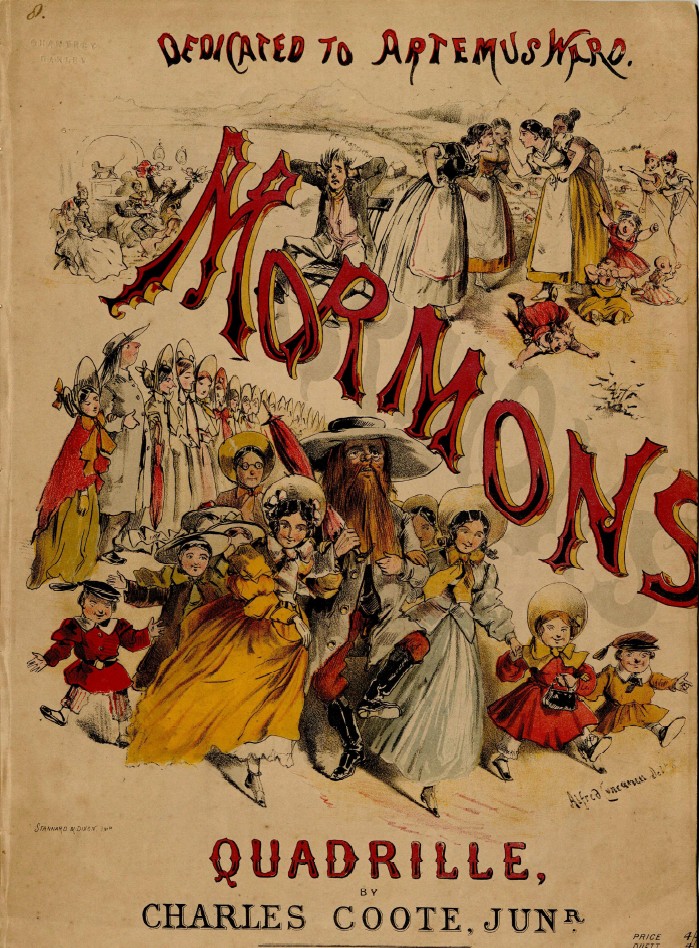
The Mormons Quadrille (1860s?) – In the era of Gilbert & Sullivan there were many other composers producing light operetta and similar “music hall” entertainment. One such musician was Londoner Charles Coote, Jr., who wrote dozens of crown-pleasing works. Little is known about this piece except that from the cover art of the sheet music it appears to have been a comic farce lampooning polygamy and American Bravado. Based on the many musical quotes included, it seems to be an instrumental suite rather than an overture from a play. More details to come later when the video is completed, but you can listen to the audio now – so click for a listen, if you dare. There will certainly be a video coming for this one someday due to the many musical quotes, references and quirks of the piece. Thanks go out to the Special Collections department of BYU’s Lee Library who supplied a copy of the sheet music from their holdings. (Click below to play.)
Utah March of 1858 by Emanuel Marquis Apart from the title there is nothing particularly connecting either the composer or the music to the region. From a time when composers churned out volumes of sheet music for a music-hungry public, this is what it is – a simple, but unremarkable addition.
The Mormon War – A Grand March by Peter Ricksecker from 1858. The title is striking, but maybe not as dramatic as it teases. There was certainly a series of troublesome conflicts around 1858, about a decade after the pioneers settled in Salt Lake City. The episode became widely known as the “Mormon War.” Actually, it was more of a diplomatic power struggle, as the leaders in Washington DC did not like the way the Mormon (now LDS) leaders in the Utah Territory were running things in ways that the Feds did not approve of. (Participle dangled.) Troops were even sent to Utah as a show of federal force, with the side benefit that several military bases were established throughout the conflict, and those added to the cultural variety in the region. However despite the tensions cooler heads prevailed, and little happened other than posturing and taunting, which continued until Utah was finally granted statehood in the 1890s. But the name “Mormon War” was catchy, so composer Peter Ricksecker of the musically minded Moravian Church movement in Pennsylvania wrote this piece to capitalize on the news of the day. While it is clearly tied to Utah by subject and title, the composer himself probably had no serious connection to Utah. While not by a Utah Composer per se, it is welcome here as a relative. Shots fired, but War settled. This is another recording by Tim on Fiverr, but for this one he not only played and recorded it, he also solved a musical mystery by extracting a playable score from the original which had several pages of inky notes smudged together due to previous water damage in the archived sheet music.
Brigham Young – Grand March – from 1873 by Edward Mack. Again, not a Utah composer, but shared here because of the subject. Tuneful rather than “Grand”, but still a pleasant if rather repetitive march. The composer is lesser known now, but was quite prolific in his day, publishing more than 100 pieces as sheet music in the late 1800s despite having lost his eyesight as a Young adult. (Get it? Young? … oh, nevermind …)
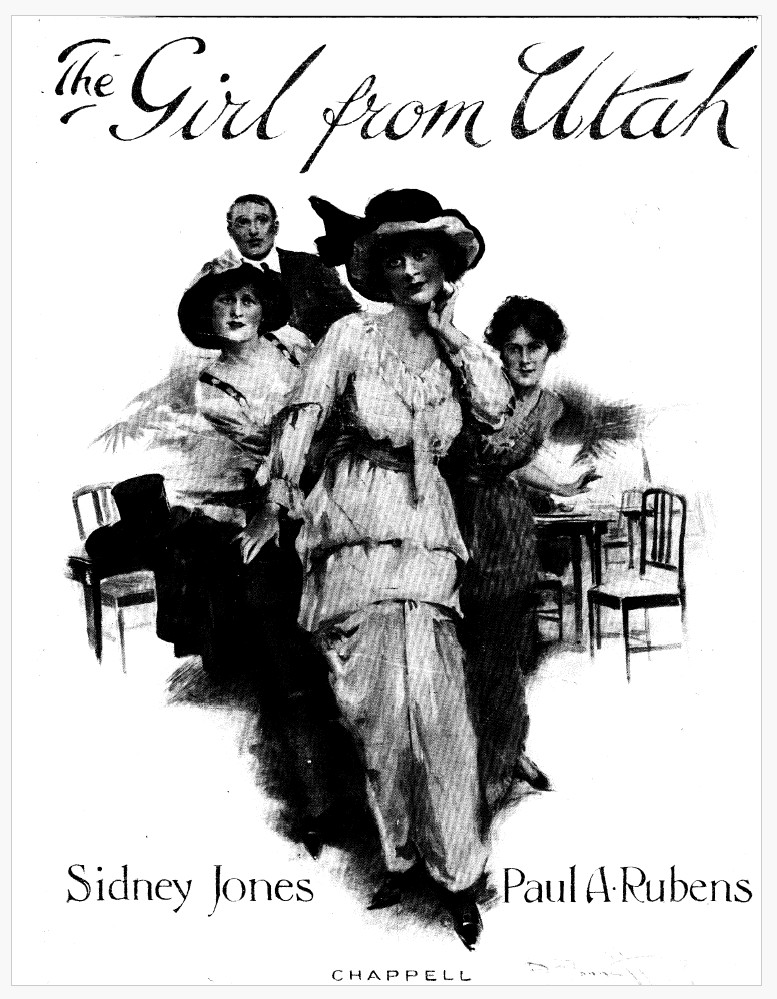
“The Girl from Utah” was a musical comedy which debuted in London in 1908. The plot was that a wonderful young woman from Utah moved (escaped?) to England to avoid an arranged marriage to a Utah man she did not love. There she met a variety of people who, at first, treated her as a curiosity, with lots of culture clash plot points. But eventually she charmed them, especially one man. When her spurned suiter arrived from Utah, her new continental friends helped her escape his clutches to marry the new guy. This work originated in England at a time when anti-Mormon (and by extension anti-Utah) books, songs, plays, etc. were common. Some were quite serious in tone, but many were more comedic, such as this one. The play was moderately popular, and was revived in New York a few years later with additional new songs by Jerome Kern. These selections from the original London staging feature works by two different teams of composers and lyricists, who each wrote complete songs but did not appear to share credits on songs. This short suite presents only the instrumental passages from the original score’s piano reduction. It includes 1) an Introductory Chorus, 2) a Dance, 3) a long Tango, and 4) a final “Russian Dance.” (An audio-only recording. Click to play.)